Article by Ward R Stern.
When working in a foreign and potentially hostile environment, the EX-PAT EOD/UXO contractor should always remain vigilant of the peripheral dangers, not the least of which is the potential from an insider threat. Whether it is an intentional act on the part of a nefarious character that has slipped through the vetting process or hazards manifesting due to the improper actions of a local hire employee; the informed EX-PAT EOD/UXO contractor technician becomes aware and is therefore better able to establish an effective protective posture plan against the potential of hazards which can approach and attempt to penetrate their protective security sphere from any direction or location.
An example of a real world situation in which vigilance paid off for me and the safety of others occurred back in 2010 when I was assigned as a Technical Advisor to an Afghanistan citizen comprised UXO team trained to International Mines Action Standards (IMAS). The team to operated in Samangan Province, Afghanistan and consisted of thirteen IMAS (Levels 1-3) technicians led by an Afghan Team Leader (IMAS Level 3). My direction (instructions received while in Kabul) was to mentor this team so that they could operate in a safe, efficient and effective manner. One facet of the assignment involved advising the team on best practices involving UXO safety, identification and disposal operations.
A primary focus of the team, observed on my arrival in Aibak, Samangan in early September 2010, was for them to travel out to villages in our area of operations and present UXO identification and safety awareness presentations to villagers. The team would liaison with a village elder or Malik (a village religious figure) prior, and set up a date, time and place (most times just a flat spot in the village where a carpet was placed) to conduct a presentation.
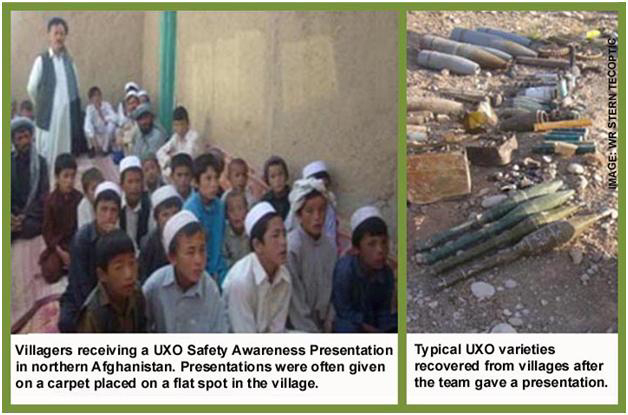
After a presentation had been made, the team leader would inquire if anyone in attendance had knowledge of the whereabouts of any UXO in proximity to the village. This inquiry would at times illicit a positive response from a village member that they had knowledge of the whereabouts of an ordnance item. The team would then, in theory, either dispose of the item or items in situ (i.e. blow in place [BIP]) or (if safe to transport) relocate and secure the item at a designated disposal range for disposal by detonation.
[More]